Paediatric Arrhythmias
Recognition and management of cardiac rhythm disturbances in children
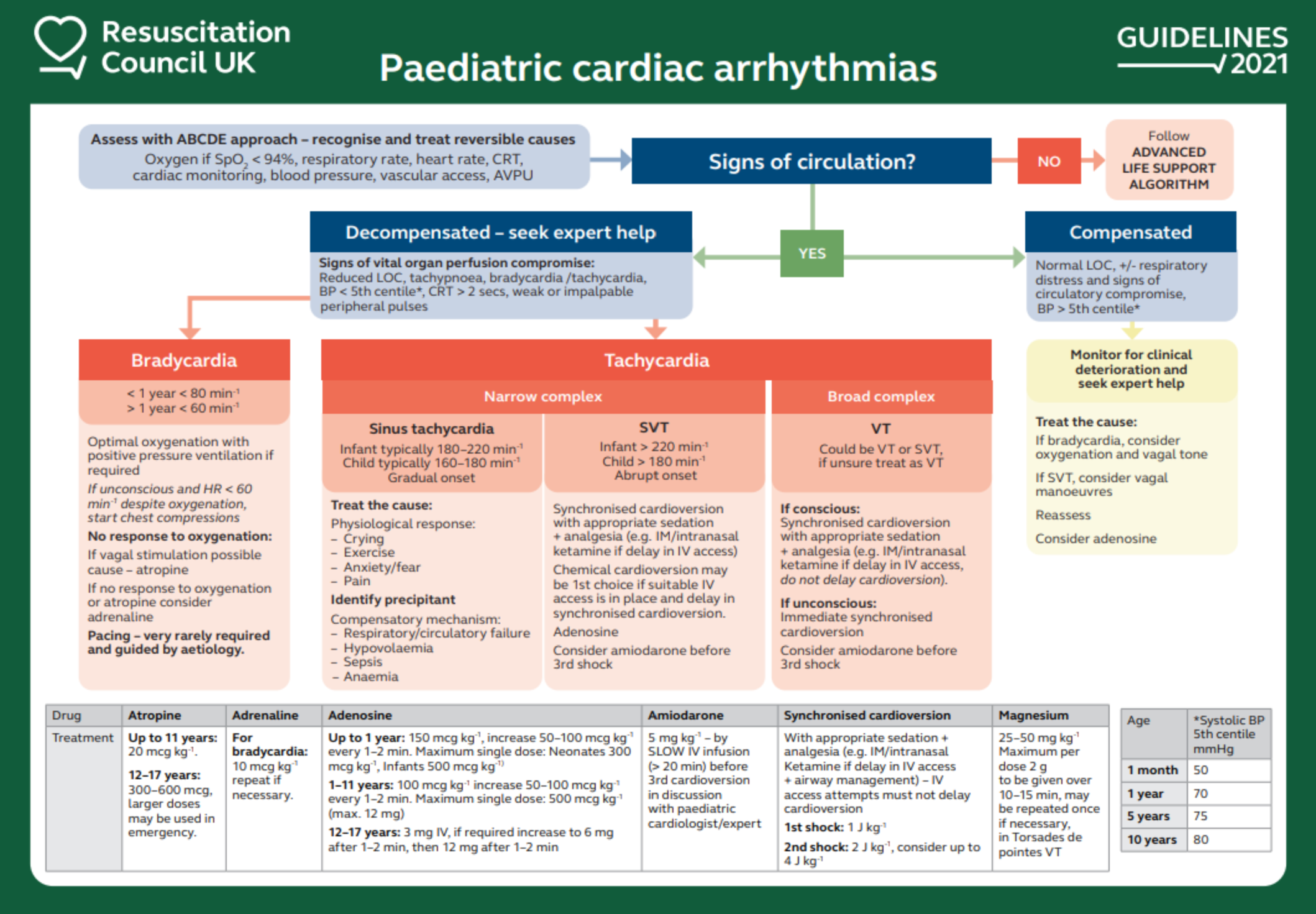
Recognition
Bradycardia
- Heart rate <60 bpm
- Rapidly falling HR with poor perfusion
- Usually pre-terminal rhythm
- Secondary to profound hypoxia/ischemia
Tachycardia
- Sinus tachycardia:
- Infants: up to 220 bpm
- Children: up to 180 bpm
- Tachyarrhythmia:
- Infants: >220 bpm
- Children: >180 bpm
- ECG required for rates >200 bpm (infants) or >150 bpm (children)
ECG Characteristics
| Arrhythmia | Features |
|---|---|
| SVT | Narrow QRS, absent P waves (most common non-arrest arrhythmia) |
| VT | Wide QRS complex |
Causes
Bradyarrhythmias
- Hypoxia/shock (pre-terminal)
- Raised ICP
- Post-cardiac surgery
- Congenital heart block
- Long QT syndrome
- Poisoning (digoxin, beta-blockers)
Tachyarrhythmias
- Congenital conduction pathway abnormality
- Poisoning (TCAs, procainamide, quinidine)
- Metabolic (hyperkalemia)
- Post-cardiac surgery
- Cardiomyopathy/myocarditis
- Channelopathies (e.g., long QT)
Presentations
- Verbal children: Palpitations
- Pre-verbal: Poor feeding
- Severe cases: Heart failure or shock
Management of Bradycardias
ABC First!
Always assess and treat airway, breathing, circulation before pharmacological management
Hypoxia/Shock
- High-concentration oxygen
- Bag-mask ventilation/intubation
- Volume expansion (10ml/kg crystalloid)
- Chest compressions if needed
- Adrenaline:
- 10 mcg/kg IV bolus (if above ineffective)
- Infusion 0.05-2 mcg/kg/min (if still ineffective)
Vagal Stimulation
- Adequate ventilation
- Atropine 20 mcg/kg IV/IO (min 100mcg, max 600mcg)
- May repeat after 5 minutes (max total: 1mg child, 2mg adolescent)
Poisoning
- Seek expert toxicology help
Management of SVT
Shocked Patient
- Vagal maneuvers only if no delay
- If IV access quicker than defibrillator: adenosine
- Otherwise synchronized DC shock:
- First attempt: 1 J/kg
- Second attempt: 2 J/kg (consider amiodarone)
Stable Patient
- Vagal stimulation with ECG monitoring:
- Diving reflex (iced water to face)
- Carotid sinus massage (one-sided)
- Valsalva in older children
- If unsuccessful: Adenosine
Attempt Dose Max Dose 1 100 mcg/kg rapid IV bolus 500 mcg/kg (300 mcg/kg if <1 month) 2 (after 2 min) 200 mcg/kg 3 (after 2 min) 300 mcg/kg 4* 400-500 mcg/kg Max total 12 mg - If still unsuccessful: Consult paediatric cardiologist
- Synchronized cardioversion
- Amiodarone
- Other antiarrhythmics (propranolol, flecainide, digoxin)
Management of VT (With Pulse)
Shocked Patient
- Synchronized DC shock 2 J/kg
- Repeat with 4 J/kg if needed
- Consider amiodarone
- If sync mode fails, may need asynchronous shock
Stable Patient
- Early paediatric cardiology consult
- Options:
- Amiodarone 5 mg/kg over 20 min (30 min in neonates)
- Procainamide
- Verapamil
- Synchronized cardioversion
- Do not delay treatment - may deteriorate to pulseless VT/VF