Introduction
During elective anaesthesia, a failed airway occurs in 0.01 - 0.03% of cases. A difficult intubation occurs in 1.15 - 3.8% of cases. However, the characteristics of patients requiring intubation or assisted ventilation outside the operating room are different to those undergoing elective surgical procedures, and the incidence of difficult intubation is significantly higher in emergency departments.
Emergency Setting Warning
A failed airway may occur at least ten times more frequently in the emergency setting. Given this data, difficulties with the airway must be expected in all emergency patients and appropriate preparation undertaken.
Definitions
Difficult Mask Ventilation
Occurs when the patient's anatomy or injuries make it impossible to maintain adequate ventilation and oxygenation with a facemask and simple airway adjuncts alone.
Difficult Intubation
Defined when an experienced laryngoscopist, using direct laryngoscopy, requires:
- More than two attempts with the same blade
- A change in the blade or an adjunct
- Use of an alternative device or technique
Difficult Laryngoscopy View
Classified by Cormack and Lehane and defined as being unable to see any portion of the vocal cords with conventional laryngoscopy (grades 3 and 4).
Difficult Cricothyroidotomy
Patient-specific features may render the cricothyroid membrane inaccessible, making induction of anaesthesia particularly risky because if the airway is lost it may be irretrievable.
General Assessment
Pre-anaesthetic assessment of emergency patients where time allows:
Comprehensive History
- Details of current condition
- Current medication and allergies
- Previous medical and surgical problems
- Previous anaesthetics and airway history
- Last oral intake
Physical Assessment
- Cardiorespiratory status
- Conscious level
- Focal/global neurological signs
- Assessment of face and neck
- Assessment for pneumothorax
- Abdominal and pelvic assessment
- Body morphology
Predicting Difficult Airways: LEMON
The LEMON mnemonic can be used to remember how to assess for difficult intubation.
| LEMON | Assessment |
|---|---|
| Look |
Externally: Age, obesity, facial hair, sunken cheeks, small mouth, large overbite, receding chin, short muscular neck, maxillofacial trauma Internally: Poor mouth opening, high arched palate, edentulous, prominent upper incisors, macroglossia, insecure teeth or prosthesis |
| Evaluate |
3-3-2 rule:
|
| Mallampati |
Score:
|
| Obstruction |
Clinical Features: Dysphagia, stridor, muffled voice Causes: Peritonsillar abscess, epiglottitis, retropharyngeal abscess, trauma, tumor, burns, infection, anaphylaxis |
| Neck Mobility |
Cervical spine immobilisation, elderly, arthritides, ankylosing spondylitis, previous neck injuries or surgery |
Mallampati Classification
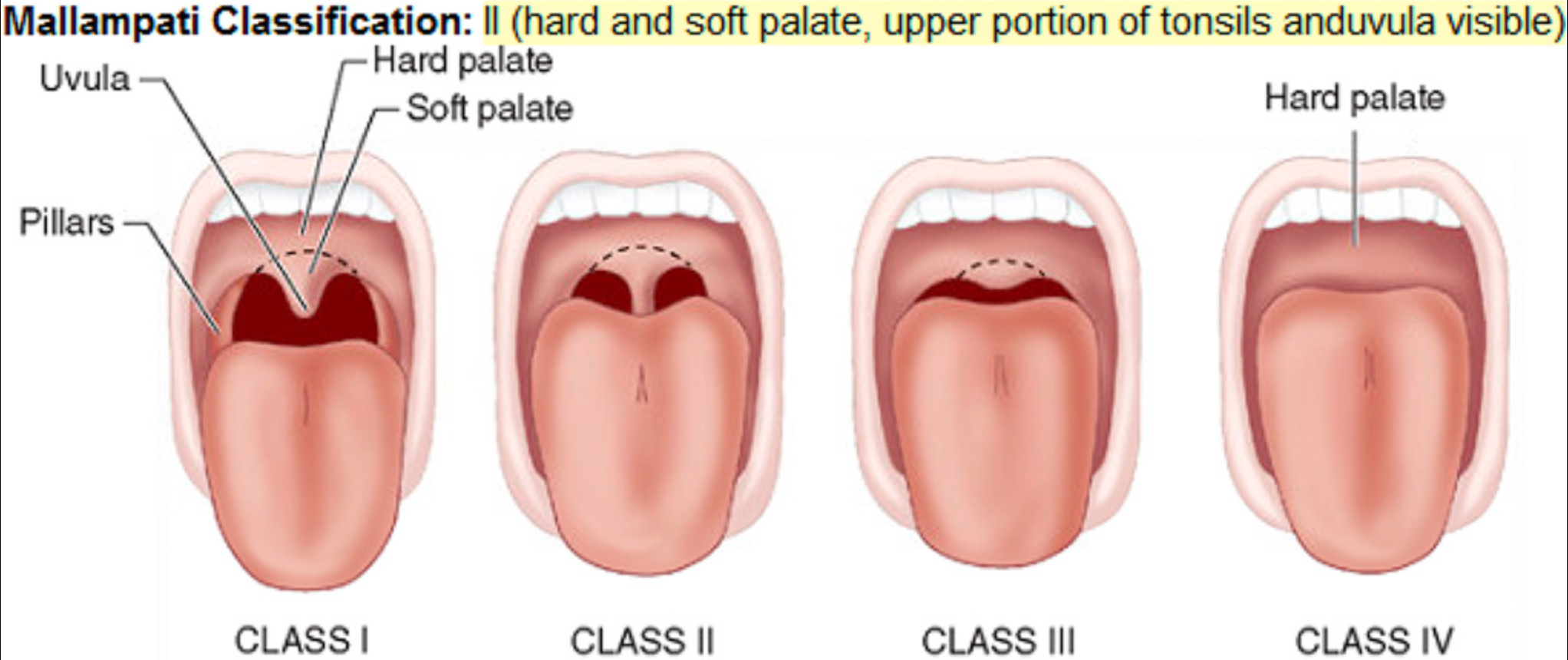
Class I
Soft palate, uvula, fauces, pillars visible
Class II
Soft palate, uvula, fauces visible
Class III
Soft palate, base of uvula visible
Class IV
Hard palate only visible
Cormack and Lehane Classification
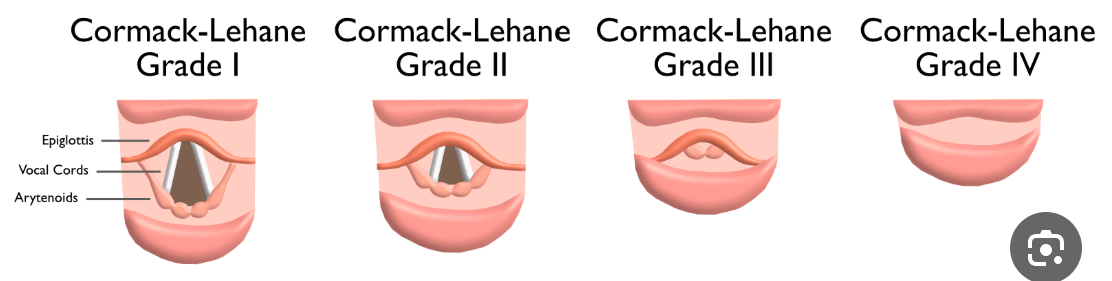
| Grade | Description | Clinical Significance |
|---|---|---|
| Grade I | Vocal cords are fully visible | Easy intubation |
| Grade II | Vocal cords are only partly visible | Moderate difficulty, may require adjuncts |
| Grade III | Only epiglottis is seen | Difficult intubation, requires advanced techniques |
| Grade IV | Epiglottis can't be seen | Very difficult, consider alternative airway management |
Clinical Implications
Emergency Setting
- Failed airway 10x more common than in elective surgery
- Always anticipate potential difficulties
- Have backup plans and equipment ready
- Consider early use of video laryngoscopy
Preparation
- Assemble all necessary equipment beforehand
- Have multiple airway devices available
- Ensure skilled assistance is present
- Prepare for surgical airway if needed
Documentation
- Record assessment findings clearly
- Note Mallampati and Cormack-Lehane grades
- Document any difficulties encountered
- Inform patient (if appropriate) about findings
Key Point
Airway assessment should be performed on every patient requiring airway management, regardless of the clinical setting. In emergency situations, always assume a difficult airway until proven otherwise.