When a foreign body enters the airway the child reacts immediately by coughing in an attempt to expel it. A spontaneous cough is likely to be more effective and safer than any manoeuvre a rescuer might perform. However, if coughing is absent or ineffective, and the object completely obstructs the airway, the child will become asphyxiated rapidly. Active interventions to relieve choking are therefore required only when coughing becomes ineffective, but they then must be commenced rapidly and confidently.
Recognition of Choking
The majority of choking events in children occur during play or whilst eating, when a carer is usually present. Events are therefore frequently witnessed, and interventions are usually initiated when the child is conscious. Choking is characterised by the sudden onset of respiratory distress associated with coughing, gagging, or stridor. Similar signs and symptoms may also be associated with other causes of airway obstruction, such as laryngitis or epiglottitis, which require different management.
General signs of choking:
- Witnessed episode
- Coughing or choking
- Sudden onset
- Recent history of playing with or eating small objects
Assessment of Severity
| Ineffective Coughing | Effective Coughing |
|---|---|
|
|
Management of Choking
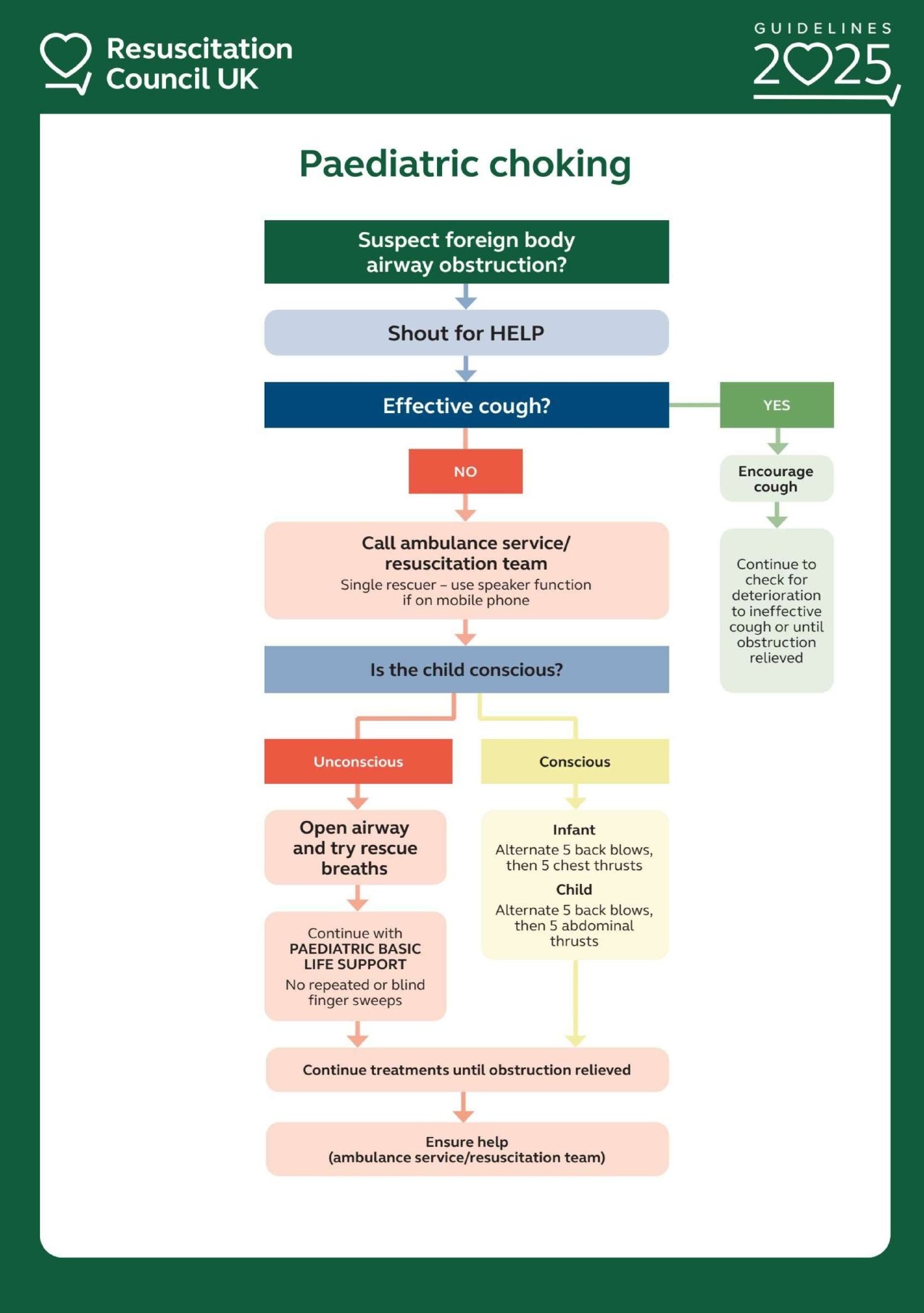
Effective Cough
- If the child is coughing effectively, then no external manoeuvre is necessary
- Encourage the child to cough
- Monitor continuously
Ineffective Cough
- Shout for help immediately
- Determine the child's conscious level
- Give five back blows
- If back blows don't work, give five chest thrusts (infants) or abdominal thrusts (children)
Unconscious Child
- Place on firm, flat surface
- Open mouth and look for obvious object
- Attempt single finger sweep if object visible
- Attempt 5 rescue breaths
- Proceed to CPR if no response
Effective Cough
- If the child is coughing effectively, then no external manoeuvre is necessary. Encourage the child to cough, and monitor continuously.
- If the child's coughing is, or is becoming, ineffective, shout for help immediately and determine the child's conscious level.
Ineffective Cough
- If the child is still conscious but has absent or ineffective coughing, give five back blows.
- If back blows do not relieve choking, give five chest thrusts to infants (< 1 year) or abdominal thrusts to children.
- If the object has not been expelled and the victim is still conscious, continue the sequence of back blows and chest (for infant) or abdominal (for children) thrusts. Call out, or send, for help if it is still not available; do not leave the child at this stage.
- If the object is expelled successfully, assess the child's clinical condition. It is possible that part of the object may remain in the respiratory tract and cause complications. If there is any doubt, seek medical assistance.
Unconscious Child
- If the choking child is, or becomes, unconscious place him on a firm, flat surface. Call out, or send, for help if it is still not available; do not leave the child at this stage.
- Open airway
- Open the mouth and look for any obvious object. If one is seen, make an attempt to remove it with a single finger sweep. Do not attempt blind or repeated finger sweeps – these can push the object more deeply into the pharynx and cause injury.
- Rescue breaths
- Open the airway and attempt 5 rescue breaths. Assess the effectiveness of each breath: if a breath does not make the chest rise, reposition the head before making the next attempt.
- Chest compression and CPR
- Attempt 5 rescue breaths and if there is no response, proceed immediately to chest compression regardless of whether the breaths are successful.
- Follow the sequence for single rescuer CPR for approximately 1 min before summoning help (if this has not already been done by someone else).
- When the airway is opened for attempted delivery of rescue breaths, look to see if the foreign body can be seen in the mouth. If an object is seen, attempt to remove it with a single finger sweep.
- If it appears that the obstruction has been relieved, open and check the airway as above. Deliver rescue breaths if the child is not breathing and then assess for signs of life. If there are none, commence chest compressions and perform CPR.
- If the child regains consciousness and is breathing effectively, place him in a safe side-lying (recovery) position and monitor breathing and conscious level whilst awaiting the arrival of the help.